Density for Thinning Hair
Darken the scalp beneath thinning hair so the contrast disappears and coverage looks fuller.
Read moreThe hairline is the first thing anyone reads on a face. Getting its shape right matters more than any other decision in the whole treatment.
Receding temples and a retreating front line change how old you look far more than density loss at the crown, because the hairline frames every expression you make. SMP rebuilds that frame by placing follicle-depth pigment where hair has gone, restoring the shape without touching a scalpel.
Before any pigment is placed, your hairline is drawn on and adjusted with you holding a mirror. We look at your temple recession, the width of your forehead, your facial symmetry and — critically — your age. A 24-year-old and a 52-year-old do not get the same line, and pulling a hairline too low or too straight is the single most common way SMP ends up looking artificial.
The finished edge is intentionally soft. Real hairlines are irregular, with scattered lighter follicles ahead of the main density rather than a hard border. We build that broken edge in deliberately, using lighter deposits at the front and increasing depth behind them.
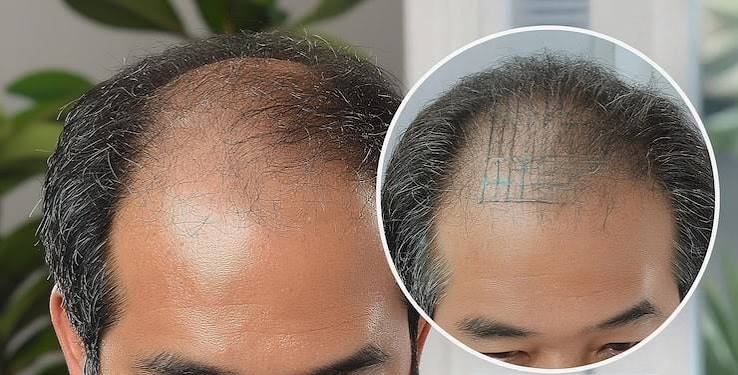
A hard hairline is a defined, clean front border — it suits younger clients, darker hair colours and anyone whose natural line was strong before it receded. A soft hairline scatters lighter deposits forward of the main density, mimicking the way a real hairline thins out gradually. It is more forgiving, ages better, and is what we recommend for most clients over about thirty-five.
We can also blend between the two, or build a soft line now with the option of tightening it later. That flexibility is one of the practical advantages of building over three sessions rather than committing in one sitting.
Lower than your current one, but not as low as it was at eighteen. A hairline that ignores your age is the most obvious tell that work has been done. At the consultation we mark a line that restores the frame while still reading as your own.
Often, yes. SMP can add density between transplanted grafts that were placed too sparsely, and can camouflage the pluggy or uneven look that older transplant techniques left behind.
If you have hair remaining behind the line, we build density that blends with it so the pigment works at short and medium lengths. If you keep it shaved, the line is designed for that. Tell us which at the consultation — it changes the design.
Darken the scalp beneath thinning hair so the contrast disappears and coverage looks fuller.
Read moreBreak up FUT strip scars, FUE dot scars and surgical marks so they stop catching the light.
Read moreEven, natural coverage for alopecia areata, totalis and diffuse patterned loss.
Read moreConsultations are free, private and no-pressure. We map the shape, match the pigment to your skin tone and give you a straight answer on what SMP can and cannot do for your pattern of hair loss.