Alopecia Coverage
Even, natural coverage for alopecia areata, totalis and diffuse patterned loss.
Read moreScar tissue takes pigment differently to healthy scalp. Treating it well is a slower, more careful piece of work than standard SMP — and it is some of the most satisfying we do.
A scar reads as a scar because it is smooth, paler than the skin around it, and has no follicles to break up the light hitting it. That is true of an FUT strip scar running ear to ear, of the scattered white dots left by FUE extraction, and of scarring from injury or surgery. Camouflage SMP addresses all three by restoring texture and colour to the tissue.
Scar tissue is less predictable than normal scalp. It can absorb pigment greedily in one spot and reject it in the next, and it heals differently. That means lighter passes, more sessions, and a test patch first — we place a small amount of pigment, wait for it to settle, and see how your tissue actually behaves before treating the whole area.
Expect meaningful improvement rather than total disappearance. A well-camouflaged strip scar stops being the thing you notice when someone stands behind you, and lets you wear your hair much shorter than you could before.
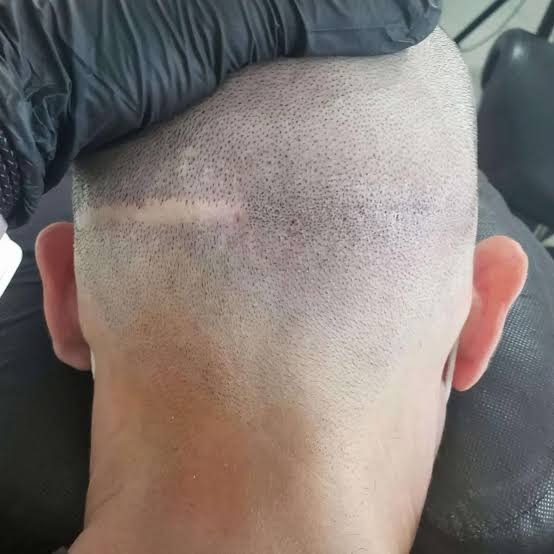
Before any full scar session, we treat a small section and let it heal for two weeks. That tells us how much pigment the tissue holds, whether it spreads, and what tone it settles to. It adds a fortnight to the process and it is not optional — treating an entire strip scar without knowing how the tissue responds is how people end up with a dark band instead of a hidden one.
Scar work typically needs more sessions than standard SMP, often four or five, each with lighter deposits. Blending into the surrounding donor area matters as much as filling the scar itself; a perfectly filled scar with a hard border around it is still visible.
Realistically, we make it much harder to see rather than invisible. The goal is that it stops drawing the eye and lets you wear a shorter clipper length. How close we get depends on the width, age and texture of the scar.
Give the scar at least twelve months to mature fully. Treating tissue that is still remodelling gives unreliable pigment retention and can affect healing.
Scar tissue has altered nerve supply, so sensation varies — some clients feel less there than on normal scalp, others feel more. It is generally still well tolerated.
Even, natural coverage for alopecia areata, totalis and diffuse patterned loss.
Read moreDensity work built for wider parts, diffuse thinning and traction loss along the hairline.
Read moreOmbré, powder and combo brows shaped and mapped to your bone structure.
Read moreConsultations are free, private and no-pressure. We map the shape, match the pigment to your skin tone and give you a straight answer on what SMP can and cannot do for your pattern of hair loss.